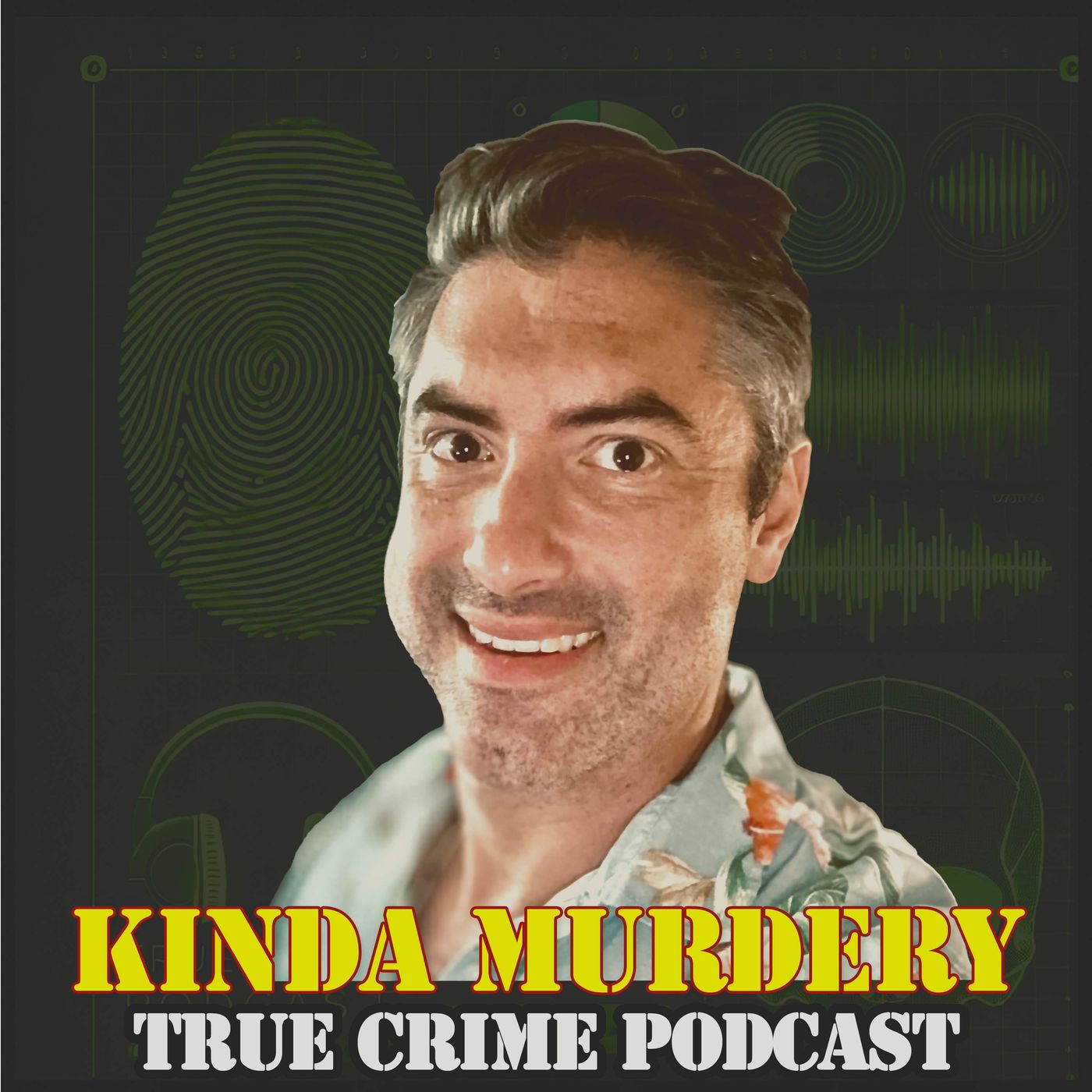
KM Classic: The Decapitation of Eddie King w/ Derek Hayes from Monsters Among Us
Become a supporter of this podcast: https://www.spreaker.com/podcast/kinda-murdery-true-crime-murder-stories--5496890/support.
Zevon Odelberg is a true crime podcast host and disability advocate. Zevon has cerebral palsy and he wants Kinda Murdery to be welcoming community for people with disabilities and for people living with challenges of any kind. Life can be hard, but being together makes it better.
Speaker 1: Hi, everybody's Zevin here. Thank you so much for joining me. I have to apologize there is no new episode of Kind of Murdery today. I just got too busy with the rest of life. I will be back though on June third for the conclusion of the besie Fara story. And in the meantime, today, please enjoy a Kind of Murdery classic entitled The Decapitation of Eddie King, featuring Derek Hayes from The Monsters among Us podcasts. I hope you like it. I know I loved recording it. Thank you once again for listening to Kind of Murdery.
Speaker 2: Warning. Kind of Murdery contains adult themes, explicit language, and descriptions of violence. It is not suitable for anyone, and we recommend you stop listening now.
Speaker 1: California's rugged and scenic northwestern corner is the beginning of the Great Pacific, northwest of the Great the region of untained and primitive beauty, and the Humboldt County Sheriff's Department has now joined efforts with the also has the highest rate of us. There's a lot of evil here, a lot of evil. This is kind of Murdery and you're entering the Emerald Triangle. Wow, that was nuts. Hey, everybody, welcome to kind of Murdery. I'm your host, zevn Odelberg. Thank you for deciding to be here today.
Speaker 1: We will be visiting the town of Samoa, California. Now, just across Humboldt Bay from Eureka, California, on a narrow peninsula, in a tsunami zone and butted up against the sand dunes, sit the coastal hamlets of Manila and Samoa, California. Given that the Pacific Ocean waters there are frigid fifty two degrees, the weather is mostly foggy, windy, rainy, chili, and the sands are gray, the irony of their Polynesian paradise names is not lost on the fewer than one thousand combined residents of both communities.
Speaker 1: Once upon a time, in the decades immediately before and after the dawn of the twentieth century, in the heyday of the redwood timber industry, flush with lagger bear and wealth, Samoa was known as Coney Island West. Today, modern Samoa is functionally a ghost town. In fact, in Samoa, ghost town is much more than just a general designation. The place is famously haunted, in particular a street of abandoned row houses known as Cadman Court. Enter one of these desolate structures at your own risk, and you might find the walls splattered with dried black splashes of old blood, evidence of clandestine ceremonies performed even now by covens of witches from Eureka who descend on Samoa's Cadman Court and meet secretly at House Number eighteen, drawing upon its dark spiritual energy to perform witchcraft and ritualistic animal sacrifice.
Speaker 1: Witches sacrificing chickens in abandoned ghost town haunted houses seems like the perfect segue to introduce my guest today. It's the Prince of the Paranormal, the Maestro of Monsters, the King of the Things that go bump in the night, mister Derrick Hayes from The Monsters among Us Podcasts. Hey Derek, thanks so much for being here.
Speaker 3: Heyze Evan, I appreciate it, and I think I'm going to steal each and every one of those introductions right there. Those were perfect.
Speaker 1: I had fun coming up with it. I was particularly proud of the King of the Things that Go bubb.
Speaker 3: The theat That was my favorite one, honestly, And you know, I write constantly for the show, and I have such a hard time coming up with new phrases and stuff like that. I feel myself repeating over and over. So congratulations on that. That's a winner.
Speaker 1: Thank you so much, so, m au Is. It's known by its legion of fans monsters among us, and I'm part of that legion, by the way, as are my wife and daughter. Now are you on break at the moment? Am I right about that?
Speaker 3: We come back today, Actually, I think the new episode posted as we're recording this. I think Sarah's upstairs toiling away getting that thing posted. And we're coming back with a special episode's special episode Tales of the Cloth, which is all religious based stories. You have churches, possessions, that kind of thing.
Speaker 1: Oh, I love that stuff, the mythos of it all. Yeah, the angels and the demons and the possessions and just kind of the epic proportions.
Speaker 3: I'm the same way, and I think I start the show saying something similar. You know, I'm not a religious person, but the historical aspect of it and the I don't want to say pageantry, that's not the right word, but the ritual of everything, it just fascinates me. And you know, there's a lot of interest there, and there's a lot of i'll call it magic for lack of a better term, but there's a lot of energy, a lot of synergy, whatever it is out there, there's there's some sort of energy connected to that that even somebody like me that's not religious can feel and can appreciate.
Speaker 1: As a huge fan of the paranormal or of true crime too, it's something about these stories that have an incredible amount of emotional leverage. Yeah, that's what the angels and demons and all the history and all the blood and all of that.
Speaker 3: Yeah. Yeah, some wild stories too. I mean, if you really break it down, there's some wild stories out there.
Speaker 1: Speaking of wild stories, So this season of Kind of Murdery is set in the Emerald Triangle, the combination of Mendocino Trinity and Humboldt Counties now Humble County, besides being the center of the wheat business, is allegedly home to Bigfoot. Derek, have you run across many cryptids in the Pacific Northwest during your illustrious career.
Speaker 3: You touched on it there, I mean if you were going to have a monster from that area, it's obviously Bigfoot. Willow Creek is in that area. I can't tell you exactly which county it's in, but that's Bigfoot Central essentially. If you go to Willow Creek, every corner has a statue or a painting of Bigfoot. There's museums, there's bookstores, and it's near where the Patterson Gimlin film was shot in nineteen sixty seven. It was in that same area. So yeah, Bigfoot's king in that area for sure. As far as anything spooky's concerned.
Speaker 1: Absolutely true. Well, Willow Creek is in fact in Humboldt County, as it is Samoa where we are going today. Shall we jump into our story of murder in mayhem in Samoa, California.
Speaker 3: I can't wait, all right, can't wait for some murder?
Speaker 1: Well, then you're in luck, because the show's called kind of Murdery. And this is the story of the murder of Edward King, a small time drug dealer from Eureka, who was killed in Samoa, decapitated and buried in the sand dunes, but possibly not in that order. And to tell you this horribly fascinating tale, I'm going to begin by taking us back to Eureka, California, on June twelfth, nineteen sixty eight. Here's what happened. The North Coast Mercantile Company at two two five First Street reported to the police that six cases of beer had been stolen from their warehouse.
Speaker 1: Later that night, a noise complaints called in from a nearby residential neighborhood, where the police find six teenagers between the ages of eighteen and nineteen having a house party with six cases of beer matching the description of those that went missing from the North Coast a mercantile case each not a bad showing. Well. The youths are arrested for disturbing the piece and then a rained on burglary charges related to the stolen beer. You know it all sounds relatively harmless, right, maybe good fun adolescent high jinks of a group of rascally friends basking in the vulnerability of being nineteen peak testosterone levels.
Speaker 1: Right. Be honest with me, Derek, Have you did you ever steal booze as a teenager?
Speaker 3: No, sadly, I didn't. I I was very boring as a teenager. I worked a lot quite frankly, I think I had like three jobs when I was in high school at the same time, so I was always super busy. I was interested in creating things in that kind. I didn't have time for trouble. That changed when I reached college, however, But when I was in high school, when I was that age, I was a good kid.
Speaker 1: No time to be shotgunning a case of blats with your buddies. Yeah.
Speaker 3: No, that came like two years later, and it was probably Stone or Natty Light.
Speaker 1: Perfect, Perfect, I feel better. So of these six beer bandits, right, one of them had a much darker path than youthful hijinks ahead of him, much darker than a noisy night of drunken revelry with the boys. He was nineteen then. His name was Freddie L. Kopic And the first part of Edward King's murder story is made up of Freddy's facts. Now I'm calling them Freddy's facts because at this point in human history, Derek, I think we all understand that even if no one is lying, and often someone is, the facts of a story can vary dramatically depending on who's doing the telling.
Speaker 3: Yeah, what's the saying History's written by the victors? I mean nobody wants to hear with the people that lost their lives has to say about about history, So it kind of applies here, I.
Speaker 1: Guess, yeah, I think it does. That's dark right on theme for the show. It makes me wonder have you ever had because I know on MAAU you have listeners call in and tell you their real life paranormal experiences, right, yeah, yeah, So have you ever had two different people call in describing the exact same paranormal occurrence with a totally different sequence of events or understanding or explanation. Is that something like that ever happened?
Speaker 3: Actually, weirdly enough, it happens all the time, and we end up with certain themes. We ended up with the mirrored men that way. You know, a couple people just started calling in and all these stories seem very similar, so we just kind of lump them all in, and before you knew it, it sort of created this character in this world that these entities or whatever these things are exist in. And then it happens at a lighter scale too. Recently, toward the end of season twelve, I had two separate calls where somebody saw a person turn into a cat and walk away, and those two calls came within, like I don't know, a couple hours of each other, from across the country.
Speaker 3: One was in the South somewhere, one was in Michigan.
Speaker 1: So that's intense.
Speaker 3: It does happen. It does happen.
Speaker 1: So you're telling me that Professor McGonagall has a twin sister, pretty much, that's a takeaways, that's what we're getting at. All right, all right, let's get back to the murder of Edward King here. So in November of nineteen seventy one, three years after the beer heist, Edward Leon King was a twenty one year old drug dealer based out of Eureka. King had a bad reputation as a drug dealer, even among other drug dealers. Now, I don't mean a bad reputation like Tony Montana, not bad, like he was a man to be feared.
Speaker 1: Edward was the nervous sort. He had a bad reputation for adulterating his merchandise and cheating his customers where he could. Probably what made him nervous. That kind of business practice can get you killed in any industry, but especially in narcotics. In fact, seems like Edward's lack of honor among thieves or I guess a fair deal among dealers, if you will, We're catching up to him. Shortly before his murder, his mother said he was planning to leave town for fear of violence. It's clear now that he didn't leave town quickly enough.
Speaker 1: Early November nineteen seventy one, Edward King left home in his car and drove out to Samoa near the dunes. He never returned home, but mysteriously his car did. When King was reported missing, Sergeant Graham of the Eureka Police spoke to Freddie Koppick, our man from the teenage beer heist three years earlier, who was now a known associate of Kings in the humble drug trade. Kopiic steadfastly denied any knowledge of King's whereabouts. Shortly thereafter, King's mother notified police of blood on the seat of her son's car, but there was no sign of him and no body was found then.
Speaker 1: Almost a year later, in October of nineteen seventy two, a headless skeleton, still wearing clothes and jewelry, was found buried in a shallow grave in the Samoa Sand Dunes. Police suspected it could be the missing man Edward King, and when King's sister identified the clothing and jewelry as matching what King had been wearing when he went missing, they were sure of it. But was it really King? Where was his head?
Speaker 3: It's a good question. We mean to interrupt you, but that's.
Speaker 1: Yeah, noticably, it's a good question. How do you positively identify a body with no head? Right? You know?
Speaker 3: My first thought here is you know, I'm always thinking problem solving to kind of come up with solutions. Here it almost sounds like he this is the first step to fake in your own death. A body with your jewelry and your clothing and no head, that would be the first I don't know how this ends, but that's the first step to faking your death, in my opinion.
Speaker 1: Gift your outfit and you're blinging to someone else, a transient or somebody, then murder them to get.
Speaker 3: Somebody up if you have to, I mean, wherever you find n so you don't even need a body at that point.
Speaker 1: A way for him to escape the violence that he saw coming. Yeah, faking your own death, it's a tried and true classic.
Speaker 3: In fact, it's safer than skip in town.
Speaker 1: Count de Monte Cristo. So, where was that head well. On November fourteenth, nineteen seventy one, about eleven months before the body was found, twenty two year old Freddy Kopk and forty year old Clayton Rumba were driving from Arcada to Eureka planning to meet up with King near the dunes in Samoa to buy drugs. They were repeat customers and King knew them well. According to Koppic, the older man Rumba was curious with King for previously cheating him out of two dollars by selling him fake LSD.
Speaker 1: Apparently there was nothing on the tabs.
Speaker 3: That's quite quite the grift right there. Depending on the person's imagination, you might be able to get.
Speaker 1: Away wait, yeah, right, exactly hey, Or depending on how messed up they are in general, maybe it was great acid and he was tweaked out or something to even notice.
Speaker 3: That that possibly could have happened to placebo effect.
Speaker 1: Now that real versus fake question, You know, one of the things that I find so captivating about monsters among us is how utterly credible the callers that you choose are. But I imagine as you listen to these calls, the issue of real versus fake must come up and I'm curious how you navigate that, Like, how do you spot somebody that's just trying to catch your attention versus somebody who really saw what they saw and experienced what they experienced.
Speaker 3: Well, the beauty of the show is that it's in the caller'sone voice, the experiencer's own voice, so you can hear right away whether or not it's affecting them, And it affects everybody different. You know, nerves hit people a different way, or you know post traumatic fear, you know, post traumatic stress, that kind of thing hits somebody a different way. So that's the first telltale right there. I can hear it in their voice. And I've done so many calls. I've listened to literally ten thousand calls probably since I've started doing the show, and now I know, you know, it's just instant.
Speaker 3: I can hear it in the first ten seconds what the person's you know, mentality is going into this. Some of the other things is if they include a lot of detail, then that's usually not always, but it could be as signed, especially when it comes to like cryptids or Bigfoot. Essentially, you know, if every single Bigfoot trope is included in this story. I kind of raise red flags there. I'm like, this doesn't happen to anybody, and it's it's you know, it's a little more far fetched. But the reality of the situation is there's almost no calls that I won't play, and I don't go around picking once because they sound more real than others.
Speaker 3: I pick mostly on subject. So it's just that the callers that call in are genuine. Ninety nine point nine percent of them are genuine. They want their story shared, and you know, they just want somebody to listen to them. They've had these experiences they can't explain and they just want to get it off their chest, some you know, some closure on what took place. So quite frankly, I don't think a lot of people are trying to feel me surprised.
Speaker 1: Probably in fact, they love your show because they feel a kinship with what's happening to people. And as you said, they need to share and be believed, and you offer them that opportunity, and that's that's fantastic.
Speaker 3: Yeah, And it happens a lot where somebody will call in and say, you know, this happened to me when I was a kid, and I've been terrified to talk about it my entire entire life. And last week you played a call that had the exact same story, you know, the exact same thing happened to somebody else, And I just want to thank you for you know, sharing that and allowing me to feel like I'm not the only person on the planet that saw this glowing figure in my bedroom or you know, whatever the case might be.
Speaker 3: Early on, I used to joke and now I think it's a bit unsensitive, but I used to joke it's paranormal therapy. Essentially, That's what it is. You know, people come on to either hear about other things that they can correlate with their stories, or they point blank share it and they want reactions. They want to hear like, am I crazy? Is this something that some other people have seen? And you know that little verification goes a long way to help people feel a little bit more normal, like.
Speaker 1: A little more normal in the paranormal. Yeah, you know, I I suppose I don't think that it's insensitive to call it paranormal therapy. I mean, I think all of us yearn for a connection in the life that we're living, in the experiences that we're having a sense of community in the way that we perceive reality. I remember hearing some veterans talk about part of the reason people believe that World War two vets were able to handle PTSD better than Vietnam vets was that they all came home on a ship, and it took about a month to get home, and during that time they were all together sharing their trauma and their experiences.
Speaker 1: And for Vietnam vets, they hopped on a plane and twenty four hours later they were back in just the regular Bucolic American world, and the reality break was just too intense.
Speaker 3: And they were expected just to make that shift that nobody can make.
Speaker 1: So I think there's I think there really is something therapeutic about the opportunity to share your experience with other people who have been there. Not that I'm trying to equate war trauma with seeing Bigfoot, but I think the point is valid.
Speaker 3: Some witnesses do, though I should point that out that some witnesses to them, it's that life and death that they thought they were going to die, And I mean, that's the ultimate fear of war, is that you're gonna lose your life or your loved ones will. So its certainly I see what you're saying by not equivalent, But to some of these witnesses it might be that makes sense.
Speaker 1: I mean, we all live in a subjective reality. It's impossible to gauge someone else's trauma. Yeah, speaking of trauma, let's get back to our murder story. Freddy Koppik and Clayton Rumbar are driving out to Samoa to meet up with King to buy drugs. Right, and as I had mentioned, and Rumba on the drive, he's really working himself into a lather over that two dollars in fake acid. Now likely this is not the first of many small clues that King ought to have heated along the way that his dishonest dealing would eventually catch up to him.
Speaker 1: Now, on the drive, Rumbas shows Kopic a twenty two caliber pistol and tells him he's going to kill Edward King for cheating him out of that two dollars worth of LSD. Some folks really hold grudges.
Speaker 3: Huh, Yeah, it's for two dollars.
Speaker 1: No, I mean, I guess, adjusted for inflation from nineteen seventy one that two dollars might be like six or eight dollars. But yeah, still.
Speaker 3: Probably forty runnestly, but even still at forty dollars, that's wow.
Speaker 1: So they meet up with King, they buy meth amphetamine. Then Kopic and Rumbas shoot up, and Kopic lures King to their car. King gets inside, Rumbab pulls out the twenty two, puts it against the back of King's skull, and shoots him in the head execution style. So no fake death, no fake death, although, as I pointed out at the start, this is Freddy Koppik's story, so we may or may not be able to rely on all the details. They drag the body out to the sand dunes. They bury it then, and this is just bizarre, but I guess they were.
Speaker 1: You know, they had just intervenously ingested a huge amount of meth amphetamine, so perhaps we're not expecting a lot of logical choices. After burying the body, they drive King's car back to his house, not bothering or at least failing to clean up the blood on the front seat, but was transferred from their clothing since they were all in Rumba's car when King was shot and blood splattered everywhere. Now, Kopick tells the authorities he had previously concealed his knowledge of King's death and the whereabouts of the body out of fear for his life and the lives of his parents.
Speaker 1: Rumba had threatened to kill them all if Kopick breathed the word of it. But upon being arrested for King's murder and subsequently put on trial as an accessory to that murder, Kopick's fear of Clayton Rumbaugh fades and he lays almost all the blame on Rumba. Ultimately, Freddie Kopick is convicted as an accessory to Edward King's murder and sentenced to five years in prison. Many questions have been answered, and it seems the stories of Edward King and Freddi Kopick have by and large been told.
Speaker 1: But there are still a couple pointedly mysterious things out there. How after almost a year did authorities finally find King's body in the first place? Number one? And again, what happened to Edward King's head? Copic is certain that the head was on when they buried the body.
Speaker 3: It's a classic mistake right there. I mean, I've done the same thing.
Speaker 1: Ye forget to forget to take the head off. Yeah, boy, I forgot that.
Speaker 3: You got to take off the head.
Speaker 1: I remembered my keys, my glasses, what testicles, spectacles, walllet and watch? Got those, but left the head on.
Speaker 3: Shit, did everything but take off the head and wipe up the blood. They almost got it.
Speaker 1: Oh boy, So how did they find the body? Where was the head? Well, for answers to those questions, we turned to the story of Clayton Rumbaugh. What became of that now forty one year old Clayton Rumba after that fateful night? Well, when Freddy Koppik tells his story prior to his trial, the authorities immediately put out a bolo on Rumba, who's apparently returned to Oregon. But they quickly discover that they're going to have to try Freddy Koppik first, because Rumba is already in jail awaiting serious charges other charges in Oregon, and the humbled authorities are going to have to wait their turn.
Speaker 1: They can't get their hands on Rumba until his Orgon trial concludes. They make the rather dubious decision to just go ahead and try Freddy Koppik in the meantime, and as I mentioned, he's found guilty and given a five year sentence as an accessory to the murder of King, which Koppik claims was committed by Rumba. So he is an accessory to Rumba's crime. So what is the deal with Rumba's organ charges and what, if anything, do they have to do with the murder of Edward King. Well, the answer is a little bit of nothing and a little bit of everything.
Speaker 1: Fair warning, this story is about to take a turn for the even grosser. But at least we get to find out one how the authorities found King's body and two where that darn head went.
Speaker 3: Now, you do a lot of these murder stories. How many of them involve a missing head?
Speaker 1: That's a good question. Is this normal? Not as many as you think. Although in one of my very first episodes, the killer was known as the Torso Killer, not the famous Torso Killer out of Cleveland actually, but a different Torso Killer.
Speaker 3: Full disclosure, I'm not a big true crime guy, but when it comes to serial killers, I'm feeling like, all right, that's bordering on paranormal almost. So there's a little bit of interest there, But I don't believe so.
Speaker 1: And so maybe it was the same guy then, and by the way, thank you for consenting to come out the show despite your lukewarm interest at the topic.
Speaker 3: No, no, I mean I love all things creepy, and my wife loves true crime, so she's gonna lost them.
Speaker 1: So what do these charges have to do with the story. Well, in some ways nothing, and in some ways everything I mentioned. This story is about to get even grosser. So hang onto your seats, or turn off the show, or whatever you need to do. But here we go. Prior to being incarcerated in a waiting trial in Organ sometime before October nineteen seventy two, when King's body was found, forty one year old Rumba is living in a trailer in Wilderville, Oregon with his girlfriend, a Miss Smith, and Miss Smith is fifteen years old.
Speaker 1: And here's here, no, and here's where it really made my stomach turn. I read many articles about this story over many years, from nineteen sixty eight to nineteen seventy five and beyond, and not at any point in this reporting is any mention made or any importance given to the fact that a forty one year old man had a fifteen year old girlfriend. I mean, they stated as a fact, but nobody states it is being problematic. Now, I did some research, and I understand at as late as nineteen seventy some news outlets in California, not related to this case, but just generally reported that the age of consent was sixteen.
Speaker 1: Still she's fifteen, and in fact, the age of consent in California had been eighteen since the year nineteen thirteen. In Oregon, the age of consent was sixteen until nineteen seventy one, when it was raised to eighteen. But again, Rumba's forty one and the girl is fifteen, So even in Oregon, this is bad. Essentially, Rumba is a pedophile, which no one finds noteworthy. A pedophile living in a trailer in Wilderville, Oregon with his fifteen year old girlfriend. But that's not germane to the story or to his character or anything, according to the reporters, which just kind of blew my mind.
Speaker 1: So around October fourth, Smith and Rumba travel from Wilderville, Oregon to Eureka. Rumba tells Smith they're going to Eureka because he's been hired to kill a man there. Great guy. Now he pays a seventy seven year old man named Earl aol Au e I'm saying ow. I don't know if I'm saying it right, but uh, that's the name. Pays him one hundred dollars to drive them to Crescent City, a town in del Noorth County, about eighty five miles north of Eureka. But when they get to Crescent City, Rumba tells the seventy seven year old he has to drive them to Eureka.
Speaker 1: And when Earl says, well, that wasn't the deal, Rumba says, if you don't drive us to Eureka, I'll kill you. I've already killed one man and I'll kill another. So Earl drives him to Eureka.
Speaker 3: Good choice, maybe.
Speaker 1: Remember this is the fifteen year old girlfriend, and I hate to even call her that, but that's what the newspaper says. This is her story. Earl drops them off in Eureka. Rumba takes Smith to a house, hands her a gun, rings the doorbell like a ding dong dasher, and tells Smith to shoot the man who answers the door. So he's immediately passing the buck on the hit he's been hired to do to his fifteen year old girlfriend. Wow, what a guy, I know, right, jeez, please welcome to the family, But a woman answers the door and tells them the man they're looking for has moved away.
Speaker 1: Rumba back in Eureka, then becomes paranoid that the murder of Edward King will be traced to him because his twenty two caliber bullet is still in King's skull. So he and Smith find their way to the Samoa Dunes, where Rumbad digs up King's skeleton and removes the head, which he puts in a pillowcase.
Speaker 3: I thought you were going to say in his rear view mirror.
Speaker 1: Trust me, Yeah, like a like an air freshener, like one of those Chrisy little Christmas trees.
Speaker 3: Oh my god, who.
Speaker 1: You know, there's probably a market for a miniature severed head air fresheners, although I don't know what scent would be.
Speaker 3: Decay, probably right and decay.
Speaker 1: By hook or by crook. They make it back to their trailer in Oregon, Rumba with King's skull in the pillowcase, and he then hides the skull underneath his bed. Mister, this is going to get traced back to me, so I got to take the head. Then goes and hides the skull under his own bed, although I guess he knows where it is that ways, but you.
Speaker 3: Know, unfortunately he knows where it is. And let me interject really quick if I may. Yeah, please, this is kind of where I come in, because when you start putting heads under beds, that's how you get ghosts.
Speaker 1: I mean everybody knows that, right, You're like, that's in the cookbook. It's in the Joy of Ghost cook It.
Speaker 3: Yes, that's page two. I'm pretty sure.
Speaker 1: Oh my gosh, that's the darkest Shel Silverstein poem ever. Right, Heads under.
Speaker 3: Beds, my children's book will be out this fall.
Speaker 1: Heads under Beds, under Birthcase. Look for it on Amazon. Yeah, yeah, I'd read it, I'd write it. So let's do it. Do it. I'll be proud to promote it on the show. Here, let's just go over these facts one more time. Rumba's afraid the murder will be traced to him, so he travels across state lines from Oregon to California in a stranger's car, a stranger who he threatens to murder. Then he attempts to have his teenage girlfriend commit a murder for hire on his behalf and he digs up Edward King's corpse, removes the head, puts it in a pillowcase, and likely hitchhikes back to Oregon with the skull in a pillowcase, the cross state lines again and hides it under his bed.
Speaker 1: What the f.
Speaker 3: What's the timeline here? I'm a little foggy on when King died as opposed to when he was dug up and had his head removed. What's the difference in time there?
Speaker 1: So he died on November fourteenth, nineteen seventy one, and the authorities never found the body. Now this is early October Ninetheen seventy two, so it's about eleven months after the murder. And you know, Derek, you put your finger right on it. Because we've answered one of our key questions, which was how did the authorities find King's body? Well, they found it after Rumbad dug it up. And question two, what happened to King's head? Rumbaugh took it. It's almost like the Greek tragedy, the story of Oedipus, when you try to avoid your fate, it's those actions that bring your fate around and it drops on you like a hammer.
Speaker 3: You're your own undoing.
Speaker 1: Right, his fear of being found out and the actions he takes are the only reason they ever find the body in the first place. Before that, they basically had a missing person. All right, Well again, what about those charges he was facing an organ and what do they have to do with all this? Right? Well, he was scheduled to be tried in Organ right when the Humbled authorities went looking for him. So what did he do to get arrested and scheduled for trial? Here's what he did. He went to Medford, Organ, where he and Smith were visiting with a married couple.
Speaker 1: When the husband allegedly made sexual advances towards Smith, Rumbab pulled a gun on the couple and held them hostage at gunpoint while Smith mutilated the husband with a can opener. Oh, those are the charges Rumba is in jail awaiting trial for. And here's how it factors into Edward King. When Rumba hears that the Humbled authorities are looking for him in relation to kings killing, He's afraid, and rightfully so obviously, that they'll find King's skull under his bed. So he calls a friend from jail and asks the friend to hide the skull for him.
Speaker 1: The friend retrieves the skull and hides it under a wash tub on his own property, until two days later when the friend's nerve cracks and he tells the authorities about the skull. Meanwhile, Rumba is convicted on the assault with a deadly weapon and kidnapping charges and sentenced to fire years in prison. He's then taken to California to stand trial for the murder of Edward King. At this point, they moved the trial from Eureka to Santa Rosa because local feeling and the notoriety of the case are running too hot.
Speaker 1: His trial in May of nineteen seventy two results in a hung jury. How is that possible?
Speaker 3: I was just thinking the same thing. I mean, it seems pretty cut and dry. He had the head under his bed, right.
Speaker 1: Right, right he did again. The disclaimer being, the first part of this story is Copy's version, the second part is Smith's version. But the fact that the head was under his bed and then under his friend's washtub, which sounds like the worst bluegrass band ever, that's just a fact. That's an established fact. That's not anyone's version of the story. Well, we've been telling everyone's story. So here's Rumbas, and it's fairly quick and simple, and it goes like this, Freddy Koppak killed King, not me.
Speaker 1: I wasn't even there. Last time I saw King was four days earlier, when I went to his apartment to buy some marijuana. I only knew where the body was because Freddy Koppick showed me. I didn't even know the body was Edward King, and listen. I took the skull because I thought it would be a funny Halloween prank to play on my fifteen year old girlfriend. And I thought it would make a funny Halloween decoration, so I hid it under my bed. Then I asked my friend to move it because I realized how incriminating it would look when they found when I found out they wanted me for King's murder.
Speaker 3: And they bought this, or enough of them bought this to hang the jury.
Speaker 1: Hm. Well, here's the thing, right, The American justice system is a piece of machinery that operates in a particular way. Rumba was a piece of garbage. But he wasn't on trial for grave robbing. He wasn't on trial for desecrating a corpse, conspiracy to commit murder murder for higher statutory rape or pedophilia. He was on trial for murder, and the jury felt that bat had not been proven and they hung. While the state wasn't about to give up, he was tried again, and the second time there was no hung jury.
Speaker 1: On January twenty fourth, nineteen seventy five, four years after the killing of Edward King, Rumba, now forty four, was acquitted for the murder of Edward King because the jury felt there was too much inconsistency in the testimony, and in particular that the state had failed to prove beyond a reasonable doubt that Rumba had killed King, or that Freddi Koppik, who testified at Rumba's trial, had not killed King. And so Rumba went to prison for five years for terrorizing the married couple in Medford, Organ and Freddie Koppik did five years as an accessory to the murder of Edward King.
Speaker 1: As for the actual murderer of Edward King, no one was ever convicted.
Speaker 3: Wow, that's that's disheartening. I'll be honest with.
Speaker 1: You, it sure is. And you know, here's a couple things that really grabbed my imagination about this one of them is almost a version of double Jeopardy, which is because they couldn't try Rumba and kopic simultaneously because of essentially a bureaucratic process where Oregon wouldn't give up Rumba in time, and they decided to go forward with Kopis trial anyway. I mean, Kopi's testimony was, look, I was there, but I didn't kill him. Rumba did. I only helped. He was convicted as an accessory. So he was convicted as an accessory to the murder that Rumba committed.
Speaker 1: That was the reason for his conviction. And yet Rumba himself was not convicted of that murder.
Speaker 3: Yeah, it's like a catch twenty two or something.
Speaker 1: Right, right, Like, wouldn't you think they had to let Kopick out or something they didn't.
Speaker 3: We're honest, It sounds like all these people need to be behind Barnes, behind bars in my opinion. But yeah, I mean, based on what you said, it almost seems like they should be. Uh, he should have been released because if there's no murder, I mean, they've they've decided that he wasn't well, I guess they didn't decide he wasn't murdered. They just decided that what was the gentleman's name, Rumba. That's right. They just decided that he wasn't involved apparently, so right.
Speaker 1: Right, But Freddie was still convicted as an accessory to Rumba murdering King, even though Rumba apparently didn't now.
Speaker 3: Didn't do it? How wild?
Speaker 1: I know, it's it's disheartening, and I find this a lot when I'm looking into stories. In season one, there was a story where a man killed an elderly woman with a clawhammer, and by the time they caught him, he was already on a parole violation for robbery with a deadly weapon, and so he was looking at five years in prison for that, And essentially they had trouble or didn't feel like it was a clean cut case to convict him for the murder, so they just said he's going to prison anyway, and they sent him back to prison for the parole violation on the five year bid for armed robbery.
Speaker 1: It seems like a similar decision was made here. The authorities just kind of said, both these guys are going to prison anyway. But it's sad when there's no real importance given to the idea of justice for a victim.
Speaker 3: Yeah, yeah, no matter what the victim was involved in.
Speaker 1: Right. And here's where I think the state made a huge mistake in trying Rumban, especially trying him the second time, because rumbab by the way testified on his own behalf and told the story that I just shared with you about I took the skull for a Halloween decoration in prank. They should never have let Freddie Koppik. They should never have had Freddie Kopic testify for the prosecution, because if you just have Rumba tell his story, then you essentially have one insane meth head telling a hardly credible, crazy ass story that no one's going to believe.
Speaker 1: But when you have copy testify, now you have another deplorable, insane meth head telling a crazy story. And now the jury gets to choose who they find more credible. And even though both stories were absolutely fucking nuts pardon my French, they found Rumbaum more credible than Freddy.
Speaker 3: Oh, it's hard to believe. The one thing I'd like to say is thankfully this was what forty five fifty years ago, but it has it really changed quite honestly.
Speaker 1: I don't think it's changed as much as we'd like to believe, especially not in terms of bureaucratic expediency. The path of least resistance, the conviction you can get or the paper you can get stamped, etc. Is what you choose because you've got too many other cases to do with. Yeah, well you know now now that I've kind of bummed everyone out here, Guess what, Derek, you get the enviable task of cheering everybody up. I guess do you have.
Speaker 3: A I brought them a long story?
Speaker 1: Well, then don't worry about cheering him out. Let's just give him a break from me. Do you have a you have a kind of murdery story you can share with us? Well?
Speaker 3: I do, and this one, this is a tragic story that I'm not involved in, but I was there for. Have you ever heard of Brian Schaeffer out of Columbus, Ohio?
Speaker 1: I haven't. Please please educate me.
Speaker 3: So essentially, Brian Schaffer was a twenty seven year old medical student at Ohio State University, and he went to a bar that I frequented often while I was I don't think I was there the same night that he was, But he walked into the bar. I had some talks, had maybe had a drink or something. There's a video of him stepping into the bar. The bar, there's a video of him stepping out, having a word, stepping back in, and then he vanishes. They can not find him anywhere.
Speaker 1: I have heard of this story, but please continue. I don't know any of.
Speaker 3: Them, shore sure, so I'll get into more detail here. So essentially, it took place on April first, two thousand and six, two thousand and six. I lived in Columbus at the time, and I frequented the bar that he went to. It's called the Ugly Tuna Saluna, and it was right on High Street, right over by Ohio State's campus. I went there all the time. I don't think I was there the night that he disappeared. Thankfully, the police didn't question me, so I'm pretty sure I wasn't there.
Speaker 1: Did you meet him before?
Speaker 3: No, I hadn't met him. Or it's a big town. I mean, Columbus had a lot of people, so I was not familiar with the guy. I only saw the news report maybe a couple weeks later, and I was like, wait a minute, you know that's the bar I go to all the time, and so essentially he came in at like one fifteen in the morning. And the way this bars designed, it's inside a building, there's no street front access to it, so you have to walk in like a movie theater, go up these escalators, and at the top there's this like chili style.
Speaker 1: Bar, so it's almost like a speakeasy of sorts or something.
Speaker 3: It's really public, like you can see clearly to bar. It's got a big k neon sign, but you have to be inside the movie theater or at least I think that's what it was at the time, and then go up to these escalators. You walk right into the bar. There's no other way in or out that's public. There's a oh my gosh, there's an access door in the back that I think is alarmed, and doesn't you have to go through the kitchen and all this other stuff to get to this thing. So there shouldn't have been any reason that he got in there.
Speaker 3: But the police scoured videos from not only in the bar, outside the bar, in the movie theater, the streets around because it was, you know, it's Columbus, Ohio state, there was a lot of street monitoring. Even back in two thousand and six. They didn't find him leave that bar at any point that entire evening.
Speaker 1: Oh my gosh, what's the name of the bar.
Speaker 3: Ugly Tuna Saluna?
Speaker 1: Oh right, you said that?
Speaker 3: Okay, wow, Yeah, that's so. Like I said, I visited this place quite often. You know, I went on dates and stuff there. It wasn't too far from where I lived, and that was the connection to me. Like when you see like news reports, I've went up those steps one hundred times. You know, I've walked through this door. I've ordered a drink here a million times. Like that's a place that I frequented. And to see somebody walk into this place and then just disappear as mind boggling. There's nowhere for them to go.
Speaker 1: Wow. And as an expert in strange occurrences, I feel like if anybody could come up with an imagination exercise to try to figure out what happened to him based on the fact that you were there all the time, I'm sure you've racked your brain about what could possibly have happened. Well, do you have any theories?
Speaker 3: I guess. I mean, I'm not an expert on the case. I've done a little bit of research and I brushed up on it this morning before we jumped on here, just so I knew what I was talking about. He had a girlfriend, he was about to leave for Miami to go on spring break, his mother had died three weeks prior, and so a lot of people that aren't close to him think that it might be, you know, taking his own life situation. But even still, how did he get out of the bar without you know, security camera seeing him?
Speaker 3: And on top of so that, there were security guards, two of them stationed right outside the door, and you can see them in the footage. So if there was some sort of foul play and they dragged the guy out of the bar, it would have been seen by these two security guards. So I'm not really a big fan of the taking his own life situation because what a weird place to even try it, And how would you even accomplish any of the things going on? So I can't help but think there was some sort of foul play.
Speaker 1: And if you do take your own life, you obviously can't hide the body, right, So yeah, it seems like if he had taken his own life, he would have almost certainly been found.
Speaker 3: This is the middle of a city, I mean, we're not talking like rural areas, right. This is the middle of Columbus, and there is a river nearby. I think it's like six blocks away, the Old Tangy, which is a small river. It's not a deep river. You could probably walk across it without you know, waste deep water probably, And they searched it. They searched the sewers, they searched everything. Now there's a little bit of weirdness that took place. And I didn't know this till today when I was brushing up, but I mentioned that he stepped out out of the bar for a moment and it was just kind of like a group of people, like right outside the entrance and still in view of the cameras from the bar, and he's talking to a few people.
Speaker 3: And he had a girlfriend that he was supposed to go to Miami with the next morning, but he was still reportedly flirting with this new girl that he met and reportedly kissed her. So that's the that's the little nugget of information that I needed to kind of go wild with my imagination. And I was thinking, well, if this girl had a boyfriend, a dangerous boyfriend, and he was somehow inside, but it's still where did the body go if any of that took place, unless they threw him in the trash or something like that and he simply got wheeled out.
Speaker 3: They were able to account for every single person that went in and every single person that went out except for Brian.
Speaker 1: You've stumbled upon an inkling of a motive, but still the shear, the utter disappearance of the body.
Speaker 3: There's a motive, but there's no bad guy. I write word for this. I don't even know that this girl had a boyfriend. It's just a speculation that I made. This girl does exist, you can see her on the video, but outside of that, I don't know much about her. And you know, weirdly enough too. At the time or this morning, when I was brushing up, I found a timeline and it showed every bar that he went to that evening, and then where the last signal they got from his cell phone. And I'm incriminating myself.
Speaker 3: I did not I'm not involved in this, but I went to half of the bars he went to regularly. I don't Again, I don't think I was out that night, just as April, for I can't think of any reason why I was at any of these bars, but then where he got his last ping was the town just outside of town. I lived in a suburb of Columbus that I lived in Hilliard, So it was like right on my trail when I saw that this morning, I'm like, man, this guy had the same circles I did.
Speaker 1: Well, so, wow, you're brave. You're basically coming on a show called kind of Murdery and heavily implying that it could have been you.
Speaker 3: Well, it definitely couldn't have been me. I mean, there's video evidence there, but yeah, if that video didn't exist, I don't know if I'd be saying the things I'm saying. But yeah, it's it's wild. It's tragic to think that, you know, this up and coming guy, he was a med student, you know, he just seemed like a normal dude. He just disappeared like that. But it's also spooky to think I'm in these same places and if this guy can disappear, then I could have easily, you know, fell into the same fate.
Speaker 1: Wow. Yeah, you know, speaking of spooky, I'm dying to know more about what's coming up with Monsters among Us and what's going on with Derek ha is Could you tell us a little more about that? Sure? Sure?
Speaker 3: Well, like I said, the show comes back today or I don't know what day this airs, but it comes back on Thursday. So we got another twenty some odd shows straight without a break. So wow, get ready for that. Buckle up. And I sat down. I sat down throughout my whole break and listened to hundreds and hundreds of calls. So I have a whole new call bank for the season. I have some great calls, some dog man calls, some really good bigfoot calls, some ghost calls that really gave me the chills. So I'll be peppering all that stuff through this season.
Speaker 3: Also, it's not out yet. We don't have a date yet, but we are working on a documentary based on a string area here in southern California that we're dubbing the Barrego Triangle. Now, this is out in ANNs Ofbrego Desert State Park, which is a San Diego County area, and we shot a documentary over the summer and we're about to release it.
Speaker 1: The Barrego Triangle. Sweet, I got to learn more about that. Actually, I just moved to San Diego, so I guess I gotta find out where to go or where not to go.
Speaker 3: I guess maybe, man.
Speaker 1: Derek, thanks so much for being here with us. This has been an absolute blast.
Speaker 3: I appreciate it. Zeven. Thank you.
Speaker 1: Listen up, everybody. If you're not already a huge fan of Monsters among Us, you will be. So go to your favorite podcasting platform, subscribe, leave a review, check out their website Monsters among Us dot com. It's a wonderful ecosystem that Derek has created and an incredibly entertaining show. So please go find them, engage with them. I promise it'll be worth your while. For Derek Hayes, I'm Zeven, and this has been kind of Murdery.
Speaker 2: Kinamurderye. The Emerald Triangle is created, researched, edited, produced and hosted by Zeven Odelberg, with opening theme by Nile Madden and arct by the Gin of Lange. Available now on all podcasting platforms. If you like the show, please subscribe, review and tell your friends. You can find us on social media at Kindamurdery or email at kindamerderyat gmail dot com
 Apple Podcasts
 Castbox
 Castro
 Goodpods
 Moon FM
 Overcast
 Pocket Casts
 Podbean
 Podcast Addict
 Podcast Republic
 Spotify